
Best Automatic Sliding Gate Opener 2026 | Houston Gate Repairs
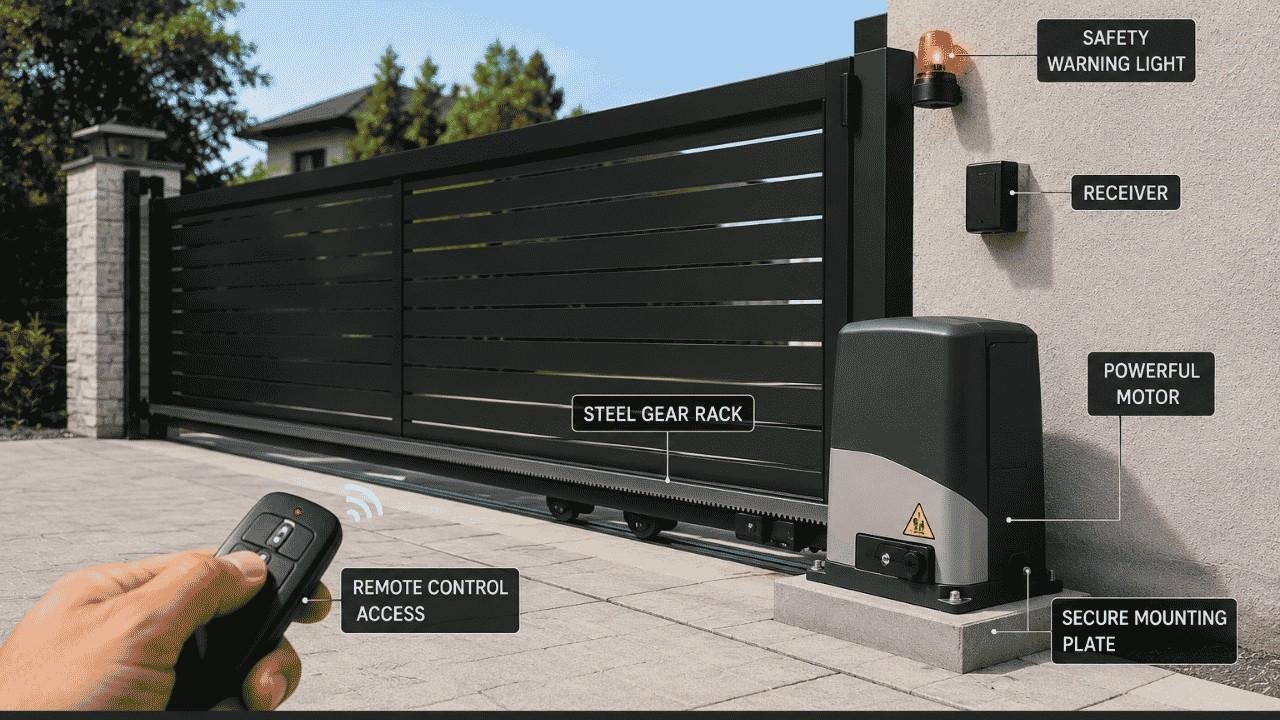

An automatic sliding gate opener is the motor and track system that pulls a sliding gate open and closed without you ever leaving your car. It’s the go-to choice for Houston driveways with limited swing room or sloped entries, and it pairs well with a residential gate repair setup if you’re upgrading an older manual gate. If your current opener is grinding, stalling, or just not keeping up with our humidity, our team can take a look and tell you straight whether it needs a fix or a full swap.
Key Takeaways
- A sliding gate opener uses a motorized drive (chain, rack-and-pinion, or wheel-drive) to move the gate along a track.
- Houston’s heat and humidity speed up wear on chains, gears, and circuit boards — yearly maintenance matters here more than in drier climates.
- Solar-powered and battery-backup openers are popular for Houston properties without easy power access near the gate.
- Installation cost depends on gate weight, motor type, and whether new wiring or concrete work is needed.
What Does an Automatic Sliding Gate Opener Actually Do?
Think of it as the muscle behind your gate. A motor mounted near the track engages a drive mechanism — usually a chain or a gear rack bolted along the bottom of the gate — and pulls the whole panel sideways. Sensors and a control board handle the start, stop, and safety reverse. Most residential setups also include a remote, a keypad, or a phone app, plus safety photo-eyes that stop the gate if something (or someone) is in the way.
If you’re starting from scratch rather than fixing an old setup, our new gate installation team can walk you through which motor size fits your gate’s weight and length.
How Do I Know If My Gate Needs a New Opener or Just a Repair?
Not every sluggish gate needs a replacement motor. Sometimes it’s a worn chain, a dirty photo-eye, or a battery that’s given up after a few Houston summers. Here’s a quick way to sort it out.
| Symptom | Likely Cause | Repair or Replace? |
| Gate moves slow, makes grinding noise | Worn chain, dry gears, debris in track | Usually repair |
| Gate stops mid-travel randomly | Misaligned photo-eye, loose wiring | Usually repair |
| Remote works sometimes, not always | Weak antenna, low battery, signal interference | Usually repair |
| Motor hums but gate doesn’t move | Burnt-out motor, stripped gear | Often replace |
| Opener won’t power on at all | Failed circuit board, blown transformer | Often replace |
| Gate is over 10 years old and acting up | General wear across multiple parts | Replace recommended |
When in doubt, a quick diagnostic visit usually settles it faster than guessing. Our gate opener repair service covers exactly this kind of troubleshooting.
What Types of Automatic Sliding Gate Openers Are There?
There are a handful of drive styles, and the right one depends mostly on your gate’s weight and how long your driveway run is.
| Opener Type | Best For | Notes |
| Chain-drive | Most residential gates | Reliable, common, moderate maintenance |
| Rack-and-pinion | Heavier gates, longer tracks | Smoother motion, slightly higher cost |
| Wheel-drive (friction) | Light to medium gates | No chain to maintain, simpler setup |
| Underground/in-ground | Properties wanting a hidden look | More installation work, less weather exposure |
For commercial properties — apartment complexes, warehouses, gated business parks — the load and duty cycle are different from a home driveway. That’s where our commercial gates repair crew steps in, since those gates run more cycles per day and need heavier-duty hardware.
Should I Get a Solar-Powered Automatic Sliding Gate Opener?
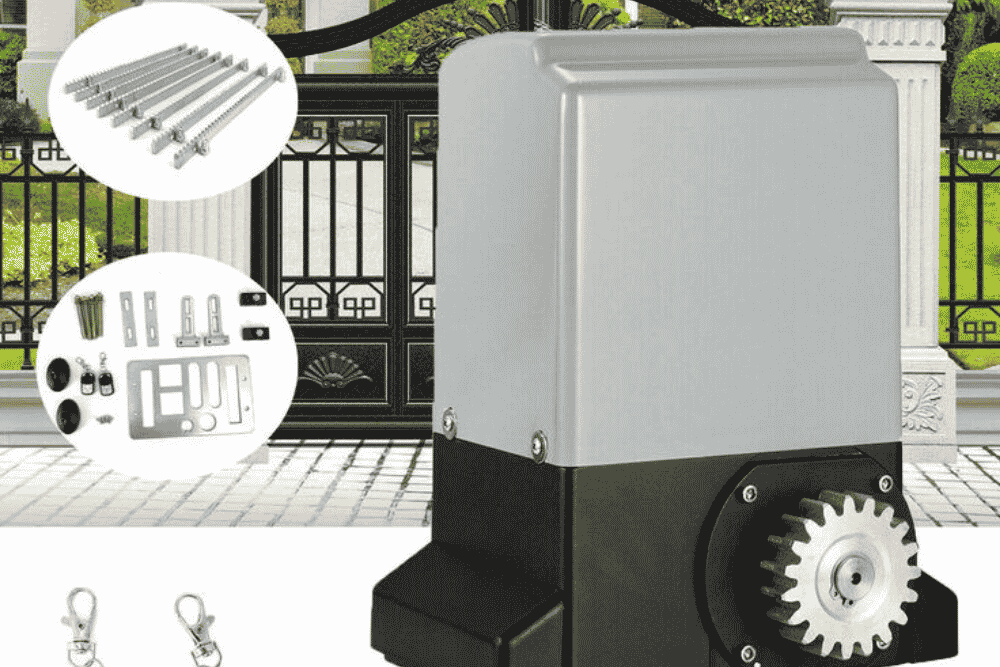
If your gate sits far from the house or a power source, running an electrical line can get expensive fast — trenching, conduit, permits, the whole deal. An automatic sliding gate opener solar setup skips most of that. A small solar panel charges a battery bank, and the battery runs the motor. Houston actually gets enough sun most of the year to make this practical, though a few cloudy weeks in winter can slow charging, so we usually size the battery a bit larger than the bare minimum just to be safe.
Solar isn’t only for off-grid properties, either. Some homeowners pick it just to avoid running a trench across a freshly landscaped yard. It’s a reasonable trade-off if you ask me — a little more upfront planning for a lot less digging.
What’s the Best Automatic Sliding Gate Opener for a Houston Home?
“Best” really depends on three things: gate weight, how often it’s used, and your budget. A light decorative gate that opens twice a day doesn’t need the same motor as a heavy steel gate at a property with constant vehicle traffic.
| Use Case | Recommended Opener Type | Why |
| Light residential gate, low traffic | Wheel-drive | Simple, low maintenance |
| Standard residential driveway | Chain-drive | Good balance of power and cost |
| Heavy gate or long track | Heavy duty sliding gate opener (rack-and-pinion) | Built for sustained, frequent use |
| Remote property, no nearby power | Solar with battery backup | Avoids trenching costs |
| Commercial entry, high cycle count | Industrial-grade chain or rack-and-pinion | Designed for daily heavy use |
If you’ve got a heavier gate — solid wood, wrought iron, or anything over a few hundred pounds — a standard light-duty motor will burn out fast. A heavy duty sliding gate opener is built with a stronger motor and reinforced gearing specifically for that kind of constant load, so it’s worth the extra cost on bigger gates.
How Much Does an Automatic Sliding Gate Opener Cost?
Automatic sliding gate opener price varies a good bit based on motor size, brand, and whether it’s a straightforward install or one with extra wiring, concrete, or solar components involved. Rather than throw out a number that might not hold up by the time you read this, the honest answer is: it depends on your specific gate and site conditions. The best way to get an accurate figure is a quick on-site or phone estimate — call (512) 957-4708 and we’ll walk through your setup with you.
What we can tell you in general terms is what moves the price up or down:
| Factor | Tends to Increase Cost | Tends to Lower Cost |
| Gate weight | Heavier gate, stronger motor needed | Lighter gate |
| Power access | New trenching/wiring required | Existing power nearby |
| Track condition | Old/damaged track needs replacing | Track already in good shape |
| Solar vs. wired | Solar add-on increases upfront cost | Wired setup with nearby power |
| Smart features | App control, keypad, intercom add cost | Basic remote-only setup |
Can I Install an Automatic Sliding Gate Opener Kit Myself?
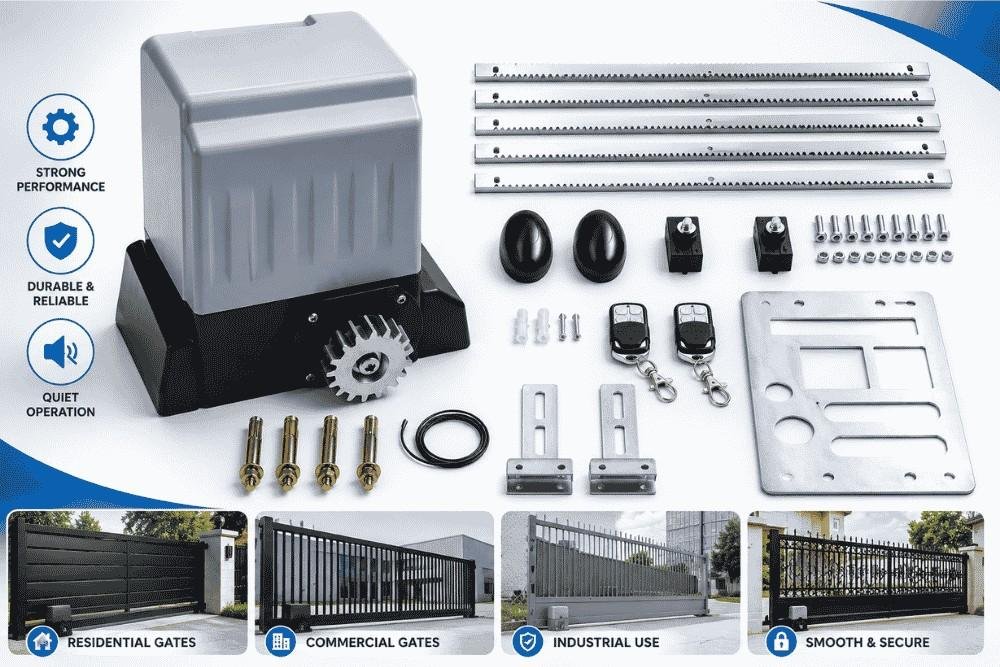
You’ll find automatic sliding gate opener kit options online that promise a weekend DIY project, and for a very light gate with easy power access, some handy homeowners do pull it off. But here’s the catch — these systems involve electrical wiring, precise track alignment, and safety sensor calibration. Get the alignment even slightly off, and you’ll end up with a gate that binds, drifts open on its own, or worse, doesn’t stop when it should.
We’ve been called out more than once to fix a kit installation where the safety reversal sensors were never wired correctly — that’s not a small thing when there are kids or pets around the driveway. If you do want to go the kit route, at least have a professional check the safety features afterward. Or skip the trial and error and have our electric gate repair team handle the install from the start.
What’s Involved in Automatic Sliding Gate Opener Installation?
A proper automatic sliding gate opener installation isn’t just bolting a motor to a post. Here’s roughly what the process looks like:
| Step | What Happens |
| 1. Site assessment | Check gate weight, track length, power access, ground slope |
| 2. Track and hardware prep | Confirm or install the rolling track and rollers |
| 3. Motor mounting | Secure the opener unit on a concrete pad or bracket |
| 4. Wiring and power | Connect to electrical source or solar/battery setup |
| 5. Safety sensors | Mount and align photo-eyes, edge sensors |
| 6. Programming | Set remotes, keypads, travel limits, auto-close timing |
| 7. Test run | Multiple open/close cycles checked for smooth, safe operation |
Skipping or rushing any of these steps is usually where problems start down the road. If your driveway is on the narrower side, it’s also worth asking your installer about driveway gate repair services in Houston, specifically, since tight driveways change how the track and clearance need to be planned.
Residential Sliding Gate Opener vs. Commercial: What’s Different?
A residential sliding gate opener and a commercial-grade unit might look similar from the curb, but they’re built for very different duty cycles.
| Feature | Residential | Commercial |
| Daily cycles | Low to moderate (a handful per day) | High (dozens of cycles daily) |
| Motor duty rating | Standard duty | Continuous/heavy duty |
| Gate weight handled | Light to medium | Medium to heavy |
| Access control | Remote, keypad, app | Card readers, intercoms, vehicle loops |
| Maintenance frequency | Annual checkup usually fine | More frequent inspection recommended |
If you manage a property with a gate that’s opening and closing all day — think apartment complexes or business parks — a residential-grade motor will wear out fast under that kind of strain. That’s a good sign; it’s time to talk to our commercial gates repair team about a unit rated for the actual workload.
How Does Houston’s Climate Affect Sliding Gate Openers?
Houston isn’t kind to outdoor electronics or moving metal parts. The humidity alone is enough to cause problems that most drier cities don’t deal with as much.
| Climate Factor | Effect on Gate Hardware |
| High humidity | Speeds up rust on chains, hinges, and exposed metal |
| Heat | Can stress motor components and battery life over time |
| Heavy rain/flooding | Water intrusion into control boxes and wiring |
| Salt air (near coastal areas) | Accelerates corrosion on metal parts |
| Sudden temperature swings | Causes expansion/contraction stress on tracks and seals |
This is really why we push annual maintenance on automatic gates around here — what’s a five-year lifespan on a chain in a dry climate might be three years here if it’s not cleaned and lubricated regularly. A quick seasonal check through our general gate repair service catches most of this before it turns into a bigger fix.
How Long Does an Automatic Sliding Gate Opener Last?
There’s no single answer — it comes down to usage, maintenance, and how exposed the unit is to weather. A well-maintained chain-drive opener on a moderately used residential gate can run for many years. A neglected one in a humid, high-traffic spot will struggle a lot sooner. Routine lubrication, sensor cleaning, and catching small chain wear early are what actually stretch the lifespan — not the brand name on the box.
People also ask
Do I need an electrician to install a sliding gate opener?
For wired installations, yes — proper electrical connections matter for both safety and code compliance. Solar setups need less electrical work but still require correct wiring between the panel, battery, and motor.
Can a sliding gate opener work during a power outage?
Most have a battery backup that handles a limited number of cycles during an outage. Solar systems with a sized battery bank tend to handle outages better than wired-only setups without backup.
How often should I service my automatic gate opener in Houston?
An annual checkup is a reasonable baseline here, given the humidity. Properties near the coast or with heavy daily use may benefit from checking twice a year.
Will a sliding gate opener work on a sloped driveway?
It depends on the slope and the track design. Some setups need adjusted track angles or stronger motors to handle an incline smoothly — this is something to flag during the site assessment.
Can I add a keypad or app control to an existing opener?
In many cases, yes, depending on the existing control board’s compatibility. It’s worth having a technician check before buying new accessories.