If your sliding gate is jumping off track, you already know how frustrating it is — especially when it happens without warning. One moment it’s working fine, the next it’s stuck halfway, grinding against the concrete, or refusing to move at all. This is one of the most common gate problems Houston homeowners and business owners face, and the good news is that most causes are identifiable and fixable without replacing the entire system.
This guide walks you through every major reason why my sliding gate is jumping off track, how to diagnose the real cause, and what to do about it step by step. Whether you handle it yourself or call a professional, knowing what’s wrong puts you in a stronger position.
Why Is My Sliding Gate Jumping Off Track — The Short Answer
Before getting into the specifics, here’s the short version: a sliding gate jumps off track when something in the support system fails — either mechanically, structurally, or from lack of maintenance. The gate is only as stable as the components holding it in place. Worn rollers, a dirty or bent track, loose hardware, foundation movement, or an overpowered motor can all send that gate off course.
The tricky part is that the actual cause is often not what it looks like on the surface. You might see the gate derailing at the same spot every time, assume the track is bent there, and miss the fact that a roller is cracked or that the track mounting bolt shifted six inches back. That’s why a proper diagnosis comes first.
Common Reasons Your Sliding Gate Keeps Jumping Off Track
Worn, Cracked, or Missing Rollers
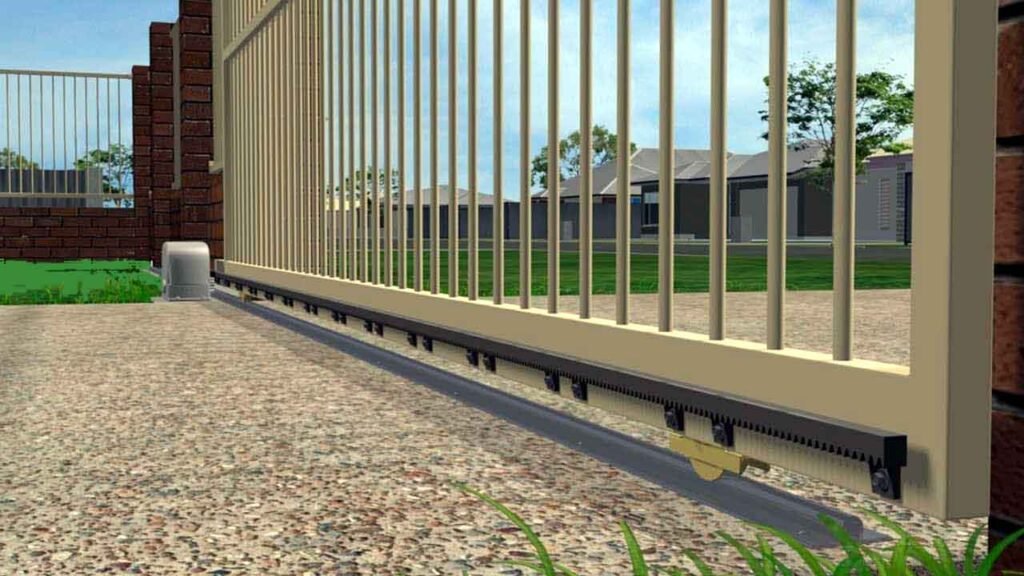
Rollers are the unsung workhorses of any sliding gate. They carry the full weight of the gate along the track, absorbing vibration and impact every single time the gate moves. Over time — especially in Houston’s humidity and heat — rollers made of cheap plastic or low-grade rubber degrade faster than most people expect.
When a roller is cracked or worn flat on one side, the gate no longer sits evenly on the track. It wobbles slightly on each pass. That wobble compounds until one rough movement throws the gate completely off. You’ll often hear a grinding or clicking sound in the weeks before this happens — that’s the roller struggling.
Signs to look for:
- Flat spots or visible cracks on the roller surface
- The gate is dragging or sounding rough during movement
- Uneven spacing between the bottom of the gate and the track
Replacing rollers with high-quality, weather-resistant ones rated for your gate’s weight is one of the most effective long-term fixes. This is also an appropriate time to schedule a professional sliding gate repair to ensure the replacement is matched correctly to your system.
Debris and Dirt Buildup in the Track Channel
This is the simplest cause and the most overlooked one. Your gate track sits at ground level, which means it collects everything — leaves, gravel, mud, standing water, and, in Houston’s outdoor environments, all kinds of organic debris after rain.
Even a small rock or a compacted clump of wet leaves can cause your sliding gate to jump off track. The gate roller hits the obstruction mid-travel, the gate jerks sideways, and if the obstruction is solid enough, the gate hops right off.
This problem is especially common after storms or during the fall when leaves accumulate quickly. The fix is straightforward: clean the track channel thoroughly with a stiff brush, remove any embedded material, and rinse with water. For commercial properties or high-traffic driveways, weekly track sweeping is a reasonable maintenance habit.
Loose or Corroded Track Mounting Hardware
The track itself is only as secure as the bolts and brackets holding it to the ground. These fasteners deal with constant mechanical stress every time the gate moves — and in outdoor conditions, corrosion sets in faster than most people realize.
Once a mounting bolt loosens or a bracket bends, the track shifts laterally or develops a slight tilt. The gate continues running on what it thinks is a straight path, but the path has moved. That’s when you start seeing the gate drift toward one side, rub against guide rollers, or eventually pop off entirely.
According to field reports from gate maintenance professionals, loose track hardware accounts for a significant portion of repeat derailment issues — particularly in systems that have never had a scheduled maintenance check since installation.
What to do: Inspect every bolt along the track length. Replace any rusted fasteners with galvanized or stainless steel hardware. Apply thread-locking compound so vibration doesn’t work them loose again. If mounting holes have become stripped or oversized from the gate shifting, a steel backing plate can redistribute the load.
This is also a good time to check your gate hardware and components to confirm you’re using the right grade of fastener for your gate’s weight class.
Bent or Warped Track Sections
A track doesn’t have to be severely bent to cause problems. A deviation of just a few degrees over a short span is enough to create a pressure point where the roller fights the geometry of the track every time it passes. That friction transfers directly into gate movement, and over time, the roller either wears faster at that point or the gate hops off.
Warping happens from several causes:
- A vehicle running over or clipping the edge of the track
- Heavy debris impact (a falling tree branch, construction equipment)
- Thermal expansion in extreme summer heat causes the metal to shift
- Ground movement from poor drainage or soil settlement underneath
You can identify a bent section by running a long straightedge along the track and looking for gaps. Even a quarter-inch deviation across a 6-foot span will show up when you look closely.
Minor warping can sometimes be corrected with careful straightening. Significant bends usually require track section replacement. Either way, if your sliding gate keeps jumping off track and you’ve already cleaned and tightened everything, the track geometry itself deserves a close look.
Foundation Shifts and Ground Movement
Houston’s soil is notoriously expansive — it swells when wet and contracts when dry. This cycle of movement, repeated season after season, puts stress on concrete footings and the track systems anchored to them. Even a quarter-inch of settling underneath one section of track throws the entire alignment off.
You might notice the gate works fine in winter but starts derailing in summer, or vice versa. That seasonal pattern is often a sign that the foundation beneath the track is moving with soil moisture changes.
This is one of the harder problems to fix because it involves the substrate rather than just the gate hardware. Solutions range from adding shims under specific track sections to re-pouring footings in areas where the settling is severe. A professional assessment is usually the right first step here — particularly for commercial gate systems where getting it wrong creates security and liability risks.
Motor Overpower or Speed Miscalibration
Here’s a cause that often gets missed: the gate motor itself. Automatic sliding gates have motors calibrated to match the gate’s weight, travel distance, and speed. When a motor is running too fast or delivering more torque than the track-and-roller system can handle, the gate doesn’t slow down smoothly at the end of travel — it hits the stop with force.
That repeated impact at the end of the run gradually shifts the track, loosens mounting hardware, and eventually creates enough play in the system that derailment happens mid-travel rather than just at the stop points.
This is particularly common in situations where a heavier replacement gate was installed on an existing motor that was never recalibrated, or where someone adjusted the speed settings without accounting for the gate’s weight. Automatic gate opener repair often involves checking these calibration settings as part of a full system diagnostic.
Guide Rollers Out of Adjustment
Most sliding gates have guide rollers — either at the top or mid-gate — that keep the gate from swaying left or right as it travels. These guides are adjustable, and they need to be set correctly: close enough to prevent lateral movement, but not so tight that they create friction.
When a guide roller is too loose, the gate has room to wander. Over time, that wandering means the bottom rollers are no longer centered on the track, and derailment follows. When the guide is too tight, it creates drag that stresses the motor and wears down the gate frame on one side.
Checking guide roller adjustment is a quick visual inspection — look for rubbing marks on the gate frame near the guide contact points. Adjustment usually involves loosening the mounting bolt, repositioning the guide, and retightening.
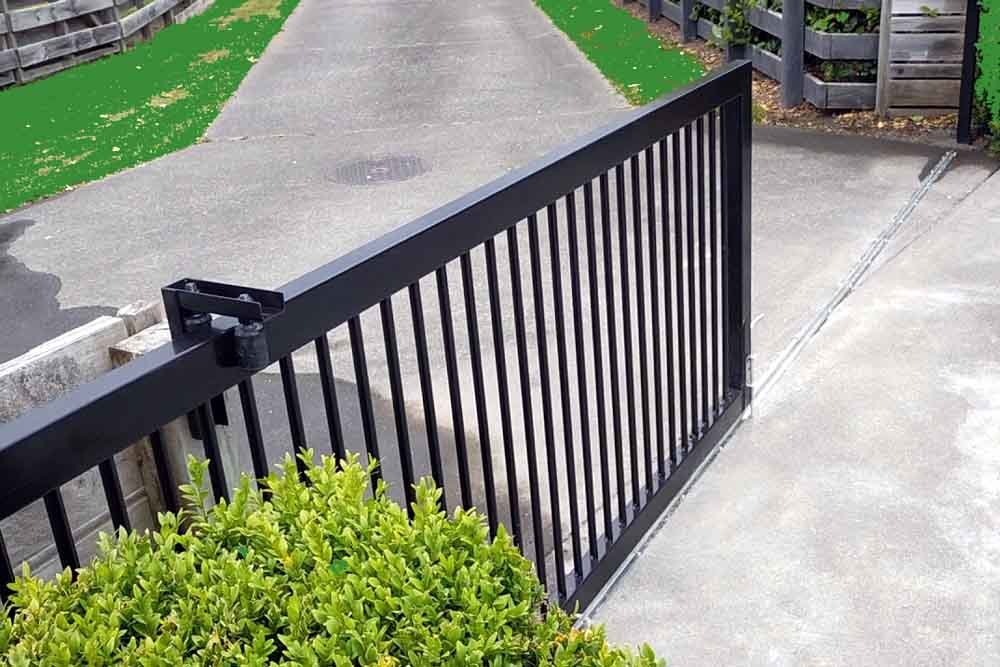
How to Fix a Sliding Gate Jumping Off Track — Step by Step
Step 1: Cut Power First
Before doing anything else, disconnect power to the automatic opener if your gate is motorized. This is non-negotiable. A gate that activates while you’re working on the track can cause serious injury. Use a wheel stop or clamp to prevent any accidental movement.
Step 2: Lift the Gate Back onto the Track
For a residential sliding gate, you’ll likely need two people. Lift the gate carefully — these frames are heavy — and seat the rollers back into the track channel. If the gate is too heavy to lift safely, a come-along or block-and-tackle can help control the movement.
Inspect the rollers as you do this. If a roller is visibly cracked, flat, or missing, note it for replacement before reinstalling.
Step 3: Clean the Entire Track
With the gate off the track (or before reinstalling), clear the track channel completely. Use a stiff wire brush on any compacted debris, rinse with water, and let it dry. If you see rust scale in the track, a wire wheel on a drill cleans it faster.
Step 4: Check and Tighten All Hardware
Walk the full length of the track and test every mounting bolt by hand. Any that turn easily need to come out, be cleaned, have thread-locking compound applied, and be reinserted. Replace anything that’s corroded to the point where the threads are compromised.
Check the guide rollers and adjust their spacing so they contact the gate firmly but without drag.
Step 5: Check Track Alignment with a Level
Use a laser level or a long bubble level to check the track across its full length. The track should be level side to side and consistent in height from one end to the other. Where you find low spots from ground settlement, add corrosion-resistant shims underneath the track mounting bracket. Aim for no more than 1/8 inch of variation across any 10-foot span.
Step 6: Lubricate the Track and Rollers
Use a silicone-based lubricant along the full track channel and on the roller surfaces. Avoid petroleum-based lubricants — they attract dust and debris that compound the problem you just fixed. Light, consistent lubrication every three months is the right maintenance rhythm for most Houston climates.
Step 7: Reinstall the Gate and Test
Lower the gate back onto the track and run it manually through its full travel range before reconnecting power. Listen for any grinding, clicking, or points where the gate hesitates. Once it moves smoothly by hand, reconnect the motor and run several full automatic cycles, watching for any drift or unusual sounds.
When to Call a Professional
Some situations are beyond the scope of DIY repair — and pushing forward without the right tools or experience can make things significantly worse:
- The track itself is bent or broken and needs replacement
- The gate is severely heavy (over 400 lbs) and can’t be safely repositioned without equipment
- Foundation issues are causing the track to move seasonally
- The motor is the root cause and needs recalibration or replacement
- The same problem keeps coming back after multiple attempts to fix it
Houston Gate Repairs provides sliding gate repair, track replacement, motor servicing, and complete gate maintenance across the Houston area. Whether it’s a residential driveway gate or a commercial automatic system, the right diagnosis the first time saves you from repeat service calls.
Preventing Your Sliding Gate from Jumping Off Track Again
Once the gate is back on track and running correctly, a small amount of regular attention keeps it there:
Every month: Sweep the track channel and remove any debris. Takes about three minutes.
Every three months: Inspect mounting bolts for tightness, check guide roller adjustment, and apply lubricant to the track and rollers.
Every year, have a professional inspection done — particularly for commercial gate repair applications where the gate cycles dozens of times per day and wear compounds faster.
If the gate is part of an access control system, annual servicing should also include sensor calibration and motor diagnostic checks to catch issues before they cause a derailment.
For an external reference on metal hardware corrosion and proper fastener grades for outdoor applications, the American Institute of Steel Construction (aisc.org) provides material specifications that apply directly to gate track systems.
People also ask
Why does my sliding gate keep jumping off track in the same spot?
A gate that derails consistently in one location usually points to something specific at that point — a bent section of track, a damaged roller that fails under load at a particular distance, a loose mounting bracket, or debris that accumulates in one channel section. Inspect that section closely rather than addressing the whole system.
Can I fix a sliding gate off track myself?
Yes, for straightforward cases like debris removal, loose bolts, or guide roller adjustment. If the track is damaged, the foundation is shifting, or the gate is very heavy, professional help is the safer and more efficient choice.
How long does sliding gate track repair take?
A basic realignment and hardware tightening takes two to four hours for most residential gates. Track section replacement or foundation-related work can take a full day or more, depending on the extent of the problem.
What lubricant should I use on sliding gate tracks?
Silicone-based spray lubricant is the standard recommendation. It doesn’t attract dust and debris the way oil-based products do, and it holds up well in outdoor conditions, including Houston’s humidity.
How often should sliding gate tracks be inspected?
Quarterly inspections are appropriate for most residential gates. High-traffic commercial systems benefit from monthly visual checks and quarterly professional service.
Why is my sliding gate jumping off track after rain?
Post-rain derailments often point to one of two causes: debris washing into the track channel during the storm, or soil movement beneath the track from water saturation. If it happens consistently after heavy rain, the drainage situation around your track foundation deserves attention.
Final Thought
A sliding gate jumping off track is never just a one-time fluke — it’s your gate telling you something in the system has been quietly failing for a while. The derailment is just the moment it became impossible to ignore.
The real mistake most homeowners make is putting the gate back on track, closing the driveway, and moving on without asking why it happened in the first place. Two weeks later, the same thing happens again — sometimes worse, sometimes with motor damage added to the original problem.
Whether the cause turns out to be something as simple as a handful of gravel jammed in the channel or something as serious as a shifting foundation, the process is the same: diagnose first, fix the root cause, then maintain consistently. A gate that gets 15 minutes of attention every three months almost never surprises you with a costly failure.
If you’ve worked through this guide and the gate is running smoothly again — great. Keep it that way with the quarterly checklist. And if the problem came back a second time, or if something in the diagnosis pointed to hardware or structural issues beyond a basic fix, that’s the moment to call a professional rather than let the problem compound further.