A gate opener battery usually lasts about 2 to 5 years, and it rarely fails all at once. The gate gets slower, starts beeping, or works fine until the power blinks and then won’t move at all. If your gate does any of that, this guide by Houston Gate Repair will help you figure out whether the battery is the problem, how to test it, how to swap it safely, and what to do if the battery wasn’t the issue.
- How long it lasts: about 2 to 5 years. Frequent outages and heat shorten it.
- What it costs: a replacement battery runs about $20 to $85
- Fast check: a resting reading under 12 volts means the battery is weak or discharged. Charge it and test again. If it still sags when the gate runs, replace it.
How long does a gate opener battery last?
Two to five years is the usual window, and where you land inside it depends on what the battery goes through. Three things do the most damage in Houston.
Heat. Battery University calls it a rule of thumb that each 15°F rise in temperature cuts the life of a sealed lead-acid battery in half. An example is a battery rated for 10 years at 77°F that lasts about 5 years at a constant 92°F. A battery sitting in a sealed operator box in direct summer sun can run hotter than the air around it, and heat damage isn’t reversible.
Outages. A battery that runs the gate through a storm outage gets drained, and each deep drain wears it down. If your street loses power a few times a year, expect the short end of the range.
Heavy use and poor charging. A gate that cycles dozens of times a day asks more of the battery than one that opens twice. A weak charger, a failing solar panel or a loose connection means the battery never fully recovers between cycles.
Humidity plays a smaller role, but it’s real. Corroded terminals cut the current a battery can deliver, which looks exactly like a dying battery. Routine gate maintenance that includes cleaning terminals and checking connections often catches this before it costs you a battery.
Signs your gate opener battery is dying
Batteries usually give warnings before they quit. Watch for these:
- The gate moves slower than it used to. Opening and closing takes noticeably longer.
- It works some days and not others. Opening and closing is inconsistent from one cycle to the next.
- Low-battery beeps or warning lights keep coming back. If they persist after the battery has had time to recharge, the battery is no longer holding a charge.
- The gate won’t run during a power outage. If the battery is the backup, this is the clearest test of all.
- The case is swollen, leaking or crusted with corrosion. Replace it now, and clean the terminals and cable ends before the new one goes in.
Any single sign can have another cause, so confirm with a test before you buy a battery.
How to test a gate opener battery before you replace it
A new battery in a gate with a different problem is $20 to $85 wasted. A five-minute test tells you which one you have. This follows the load test in Ghost Controls’ published procedure, which was written for its own openers. Check your operator’s manual first, since steps differ by model and some openers have two batteries.
You’ll need a basic multimeter.
- Disconnect the charging source (the transformer or solar panel feed) so it can’t mask what the battery is doing.
- Measure the resting voltage. Above 12 volts, go on to the load test. Below 12 volts, charge the battery externally and test again. If there are two batteries, test each one on its own.
- Run the gate and watch the meter. Record the voltage before the gate moves, then run a full open or close and watch it during the cycle.
- Repeat for several more half cycles, pausing about 10 seconds between each.
- Read the result. A drop of less than 0.5 volt per half cycle is acceptable. Bigger drops mean the battery should be replaced.
While you’re in there, look for blown fuses, damaged wiring and corroded terminals, which Elite Gates lists as things to check along with the battery. It also recommends testing at least twice a year, and before storm season is a smart time for one of them.
How to replace a gate opener battery
Swapping a battery is a job most owners can handle, as long as the gate and the opener are in good shape. Know how to release your gate manually before you start, in case you need to move it while the power is off.
- Cut power. Switch off the operator’s power supply and, if it has a solar panel, disconnect it too.
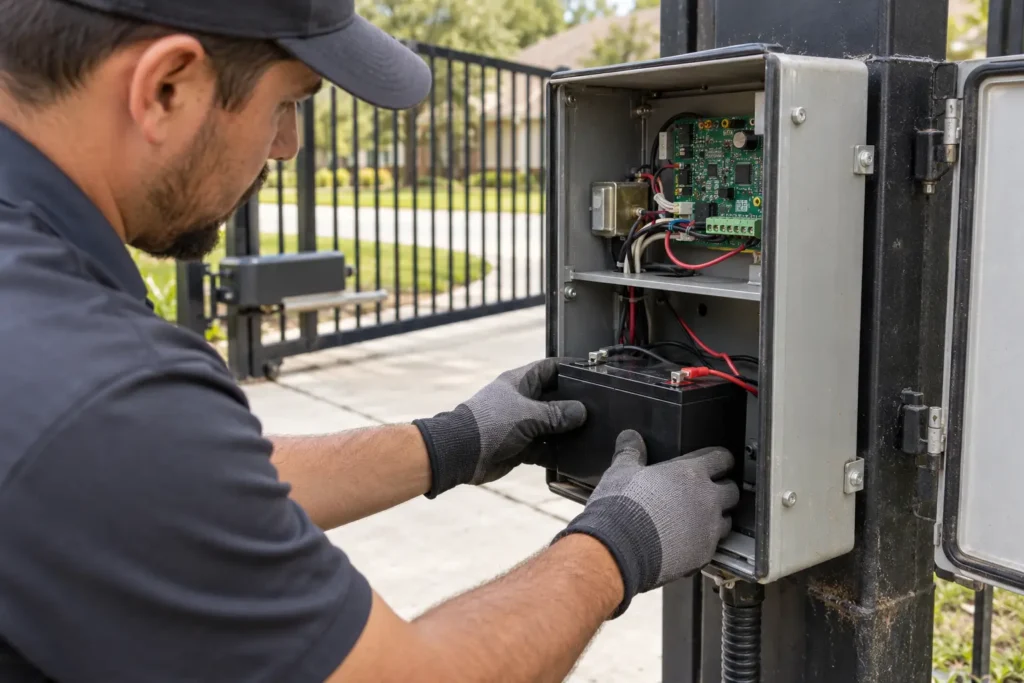
- Open the control box and note how the battery is wired. Take a photo of the connections before you touch anything.
- Disconnect the negative terminal first, then the positive. Keep metal tools from touching both terminals at once.
- Remove the old battery and clean the terminals and cable ends. Wear gloves and eye protection.
- Match the replacement. Use the voltage and amp-hour rating your operator’s manual calls for. Most are 12 volt, but don’t assume.
- Install and reconnect, positive first and negative last, making sure the connections are tight.
- Restore power, let it charge, and test. Run the gate through several full cycles and check that the safety sensors still respond.
- Dispose of the old battery properly. Take it to a battery retailer or recycling center, not the trash.
If the gate still misbehaves with a good battery in place, stop and look at the next section.
Gate opener battery types and cost
Most gate openers use a 12-volt sealed lead-acid battery. Elite Gates also names lithium-ion as a common choice. Which one fits depends on your operator and its charger, so check the manual before changing chemistry. A charger built for lead-acid isn’t automatically right for lithium.
A replacement battery costs about $20 to $85. The price tracks capacity, brand, and chemistry. Buy the best battery your operator supports. A cheap one that fails in a year costs more than a good one that lasts three or four.
Battery-powered operators are a separate purchase. Fixr lists them at $200 to $600 for the opener itself.
How to make a gate opener battery last longer
You can’t stop a battery from aging, but you can stop it from aging faster than it should.
- Keep it cool. Heat is the biggest killer. If the control box bakes in afternoon sun, shade it or move it if the manufacturer allows, and don’t seal in extra heat.
- Test it twice a year. A quick voltage and load check catches a weak battery while it’s still convenient to replace.
- Keep terminals clean and tight. Corrosion and loose connections make a healthy battery look dead.
- Fix drag on the gate. A gate that binds on a bad hinge or dirty track makes the motor draw more power on every cycle.
- Keep the charger path healthy. If you run a solar gate opener, keep the panel clean and unshaded. On plug-in systems, check the transformer and wiring.
- Replace it before storm season if it’s more than a couple of years old. A battery that’s about to fail will pick the worst day to do it.
When it’s not the battery
A fresh battery fixes a battery problem. It won’t fix a gate that’s binding, a motor that’s wearing out, or a control board that’s failed. These clues point somewhere else:
- The gate is still slow with a battery that passed the load test. Look for drag in the hinges, rollers or track before blaming the motor.
- The motor hums or clicks but the gate doesn’t move. That’s a motor, gear or mechanical problem.
- There are no lights or response even though the battery reads fine. Suspect wiring, a fuse or the control board.
- The gate won’t close or keeps reversing. Sensors and obstructions are the usual cause.
If the motor hums or does nothing at all, working through a gate motor not working checklist is the next place to look.
When the cause isn’t obvious, or it involves the control board, wiring or motor, it’s gate opener repair work. Guessing at parts costs more than a proper diagnosis, and it’s easy to replace a good battery and still have a dead gate.
And if the real complaint is that your gate won’t close, the usual causes are different: sensors, obstructions, limit settings and alignment.
FAQs
- How long does a gate opener battery last?
About 2 to 5 years. Frequent power outages, extreme heat, and heavy daily use shorten it, and cold reduces its capacity. Test it at least twice a year. - How long do automatic gate openers last?
There’s no single number, because it depends on the model, how often the gate cycles, and how well it’s maintained.The battery is a wear item that gets replaced on its own schedule, so a dying battery doesn’t mean the opener is finished. - Why is my gate opener beeping?
Persistent low-battery beeps or warning lights that return after the battery has had time to recharge usually mean it’s no longer holding a charge. Beeps can also signal other faults, so check your operator’s manual for what your model’s pattern means, then test the battery. - Can I replace a gate opener battery myself?
Often, yes. It’s a low-voltage job with a few steps, covered above. Match the voltage and amp-hour rating, disconnect the negative terminal first, and test the gate afterward. If the wiring isn’t what you expected, or the gate still acts up with a good battery, stop and get it diagnosed. - Will my gate work during a power outage?
Only if the opener has a battery or other backup, and only until it runs down. A gate that won’t move during an outage is one of the clearest signs of a weak battery. - How much does a gate opener battery cost?
About $20 to $85 for the battery itself. Labor adds to that if you hire it out.
Test first, then replace
Most battery trouble announces itself weeks ahead: a slower gate, a beep that won’t quit, a gate that stalls in an outage. A multimeter and ten minutes will tell you whether a $20 to $85 battery solves it. If the numbers look good and the gate still isn’t right, the battery was never the problem, and the sooner it’s diagnosed, the less it tends to cost.